When we start talking about formations, tactics, and strategies, it’s really quite easy to assign a team a formation — RSL setting out in a 4-4-2 meant L.A. could hold on to possession — and be done with it all. Ignoring the nuance of tactical setup, of course, doesn’t get at the heart of it, and an added degree of specificity comes into play: RSL’s diamond 4-4-2 didn’t quite have enough to fell the giants in Los Angeles, as they weren’t able to retain possession. Still, that doesn’t quite get at the heart of it, either. So we get more specific: RSL’s relatively narrow diamond surrendered possession on the flanks and conceded possession deep in the midfield. Still, something seems wrong, doesn’t it?
When we describe a team as a formation, we are forced to reduce it to a series of numbers. We might break out of the three-number variant, describing a system as a 4-1-4-1, a 4-4-1-1, a 4-1-2-3 — we could use many different sets of numbers there to attempt to narrow in on what the team is doing on the pitch. We should wonder, though, what that means — if it indeed has a meaning. There are several schools of thought, but two dominate.
The first school of thought tends to take formations as important when discussing tactics. They set up the general positioning of the players, defensive match-ups, and important attacking movements. Some will take greater specificity as desirable, and so they will tend to describe the formations as more than just defenders, midfielders and forwards, tending toward defenders, defensive midfielders, midfielders, attacking midfielders and forwards. Defensive midfielders will tend to stick back, attacking midfielders will tend to go forward, and midfielders will be of a more classical type. These between-the-lines players, a relatively recent movement — at least in their description — are more specifically role players.
The second school of thought tends to take formations as less important when discussing a match: More important will be what the players did with and without the ball, how they moved around the pitch, how they performed in their match-ups, and more. The emphasis, though, with individuals is not positioning but performance.
Of course, that’s quite a simplistic description of the two schools of thought, and few people, if any, really fit neatly into one or the other. But for the purposes of illustration, it’ll serve to distill the two ideas down.
Let’s look at an example. We can use our very own club to illustrate, as we could quite easily be described as playing with ‘between the lines’ players. Starting from the back, we’ll have the usual four — this season, it seems it’ll be Wingert, Borlave (if you’re new here, that’s Borchers and Olave. If you’re not, then it’s the same thing, but you probably already knew that.), and Beltran.
That’s a pretty typical setup, and we’ll call that the back four, as you’d expect. So far, it’s a 4-X, where X is composed of the remaining players. In the midfield, we’ll see four players, but unlike a flat “two banks of four” formation, there is an important formation variation here. Kyle Beckerman sits back in a defensive midfield role, giving us a 4-1-X. Now, that role can vary based on the team, but Kyle is more a deep-lying playmaker than a straight-up anchor man. In the more traditional midfield spot, we see two players whose roles vary based on the players around them, but they must be skilled in defending and attacking. How that balance plays out varies with the players involved, inevitably, but in general, we can call them box-to-box midfielders — they play in attack and defense, are possession-keeping players, and aren’t afraid to get into the fray with strong — but fair — tackles.
So, to this point, we’ve got a 4-1-2-X. Moving forward, we’ve got an attacking midfielder — typically the one and only Javier Morales — who is responsible for orchestrating the whole thing. Now, in the absence of Javi, we saw Kyle Beckerman pick up more of the playmaking responsibilities, and once we see both of them fit and on the pitch again we may see a much-improved take on it all. At any rate, Javi picks up another slot on the formation board, giving us a 4-1-2-1-X.
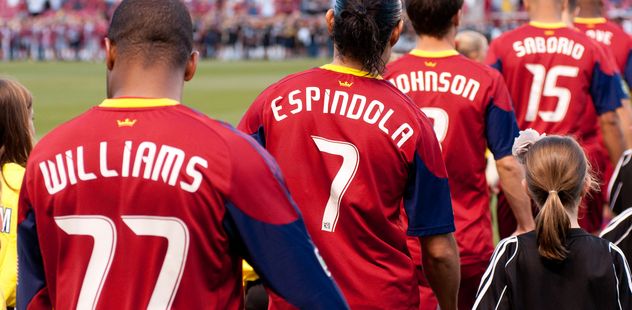
This next part is pretty simple, though it’s easy to lose some of the nuance of the two positions left on the pitch. With two forwards on the pitch, we’ve got two different roles being utilized: One, typically Fabian Espindola, who makes wide runs to draw players out of position, and one, typically Alvaro Saborio, who capitalizes on chances and is a straight-forward goalscorer. Nuance aside, though, that’s a “2” on the formation, leavings us with a 4-1-2-1-2.
Now, you’ll rightly ask why it needs to be so complicated, and I certainly sympathize with that position. Regardless of how you frame our lineup, we do have four defenders, four midfielders, and two forwards. But to more fully describe the setup, it becomes necessary to provide more detail. For some, saying we play a narrow diamond 4-4-2 will be enough, but for others, they’ll need all the detail on offer.
What remains, though, is that those numbers are meaningless without roles ascribed to them. Even with the overly specific 4-1-2-1-2, nothing separates the playmaking defensive midfielder from the anchoring defensive midfielder; nothing separates the attacking playmaker from the withdrawn forward. Without roles, we’re left with just a series of numbers and not much else — but with, we get a rich description of the formation.
When discussing Real Salt Lake’s formation, tactics and strategy during the coming season, it’ll be important to fully describe those roles and to consider formation alongside performance when making judgments about players. Sure, it’s easy to just describe the formation and be done with it — I’ve been guilty of that — but it misses the human element. And yeah, it’s easy to just describe the players’ performances, but that misses the big-picture tactical side of things. As one would expect, a healthy mixture of both is exactly what’s needed.
Comments